Age-Related Macular Degeneration Treatment
What is Age-Related Macular Degeneration Treatment (ARMD)?
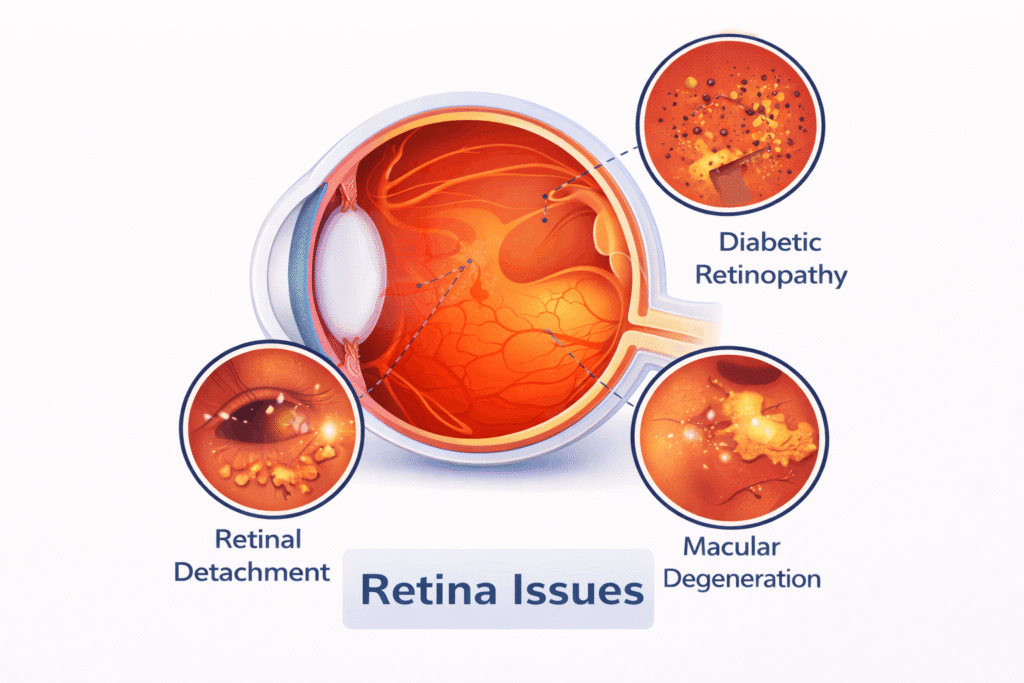
ARMD is age related macular degeneration treatment that mainly affects patients with more than 50 years of age characterized by the deposition of metabolic waste at the level of Bruce’s membrane and below the RPE , mainly of two types DRY ARMD AND WET ARMD
Pathology -deposition of metabolic waste of photoreceptors which is not cleared by RPE, causes thickening of outer retina layer and choroid which progressively leads to damage of retina and choroid, Wet ARMD which also known as NEOVASCULAR ARMD( nARMD) is more dangerous in causing vision loss because of swelling and bleeding compare to DRY ARMD OR NON NEOVASCULAR ARMD(non nARMD )
Symptoms and Risks of Age-Related
In early course of disease it doesn’t have any symptoms but as disease progression symptoms started to come
Early symptom is mild decrease in vision to metamorphopsia that is seeing the line or object zig zag , followed by central scotoma or black spot in central vision, if disease progresses further it may leads to severe vision loss
Risk factors include age more than 50years , more in male , history of smoking, hypertension, obesity , more UV exposure , dietary factor as healthy and antioxidant rich diet is preventive , race and ethnicity as disease is more common in white and Caucasian
Leading Age-Related Macular Degeneration Treatment in Gurgaon
Age-related macular degeneration (AMD) gradually affects the central part of the retina, called the macula. This area is responsible for clear and detailed vision. AMD mostly occurs in adults over 50 and can make everyday tasks like reading, driving, or recognizing faces difficult. While it is not always possible to prevent AMD, early diagnosis and effective treatment can greatly slow its progression and help protect sight.
If you are looking for top age-related macular degeneration treatment in Gurgaon, you can find skilled retina specialists at ARC advanced eye and retina centre gurugram who provide precise diagnostic and treatment options based on each patient’s needs. Our center uses technologies like Optical Coherence Tomography (OCT) and retinal imaging like autofluorescence FFA fundus photo to spot changes in the retina and monitor the condition effectively.
At ARC we have all the treatment available based on the type and stage of AMD. Wet AMD is usually treated with anti-VEGF injections, which help reduce abnormal blood vessel growth and preserve vision. For dry AMD, doctors might suggest nutritional supplements like antioxidants, lifestyle changes, and regular eye check-ups to support long-term eye health.
Choosing a right eye hospital and experienced retina specialist at right time is crucial in prevention and treatment of ARMD to prevent permanent vision loss
Comprehensive ARMD Treatment Options at ARC Eye Centre
At ARC eye and retina centre we have highly skilled retina specialist who diagnose and treat patient with AMD in very professional manner, here approach is starting from prevention and progression of disease in early stage to treatment of wet AMD , starting from diagnostic like OCT, FFA, OCT angiography, to autofluorescence
We have all the antivegf injection available to treat the wet AMD, try the minimum intervention with maximum benefit approach
Our specialists place a high priority on the need for regular follow up visits. These visits facilitate the close observation of the retinal structure and allow for modification of treatment as warranted. At ARC Eye Centre, we integrate our clinical knowledge, cutting edge technology and devoted care to our patients to provide ARMD management. We help our patients preserve their sight and have the confidence to continue their daily routines.
Advanced Diagnostic Tools for ARMD in Gurgaon
The foundation for successful ARMD treatment begins with the establishment of a precise diagnosis at the ear lstage . The application of the newest diagnostic technologies employed by our specialists enables them to discover even the most subtle changes to the macula. The specialists are then able to provide long-term care for the vision of patients.
The non-invasive Imaging Technology of Optical Coherence Tomography provides our specialists with the capability to view the layers of the retina. This helps our specialists detect the changes associated with dry and wet ARMD, as well as swelling and the accumulation of fluid in the retina. Our specialists also provide high-resolution imaging of retinal layers for documentation and assessment of the progression of this disease.
In order to have a more comprehensive assessment of the condition of a patient’s eye, our specialists may also provide fundus fluorescein angiography (FFA) to help view the flow of blood in the retina as well as evaluate the abnormal blood vessels associated with wet ARMD.
The combination of the diagnostic technologies and the skills of retina specialists at ARC Eye Centre provides the foundation for adequate ARMD care. The emphasis on precision and early detection of the disease allows patients the opportunity to receive timely treatment. This improves the outcome of the patients' vision as well as the overall health of their eyes.
Why Choose Us for ARMD Treatment in Gurgaon?
ARMD treatment is not one time treatment it involve regular follow up for whole life, to get the treatment for the ARMD patient need to choose the right eye hospital where all the diagnostic facility like OCT, FFA, OCT angiography, autofluorescence are available and surgical facilitylike operation theatre for intravitreal injection like Antivegf are available and , retina specialist who can handle complex retina cases and have enough experience who can handle it confidently
At ARC we have retina specialist who has immense experience in retina/ARMD, our specialists are well trained from premier institute like AIIMS new delhi which is world known for eye care
At ARC we have all the diagnostic and facility available at affordable cost
Book a Consultation for ARMD Treatment in Gurgaon Today
If you have blurred vision focusing in the center, reading becomes difficult, or if you struggle to identify people, don’t overlook the symptoms. They may indicate the start of Age-Related Macular Degeneration (ARMD). Macular Degeneration or ARMD worsen the central vision as you get older, day by day, if you don’t take the necessary treatment. Later it damages the peripheral vision also The sooner you seek treatment, the better the prognosis for your vision.
Dr Sunil Kumar ARMD Experts Retina Specialists provide a thorough assessment and specialized treatment for ARMD patients. For ARMD patients, Dr. S Kumar uses state-of-the-art technology in diagnostics, like Optical Coherence Tomography (OCT), and advanced detailed imaging of the retina like angiography, to assess the condition of the retina.
Dr kumar guides patients about the necessary lifestyle habits, necessary nutrients, and the need for frequent follow-ups to monitor the health and condition of their eyes, as well as the state of the treatment.
Do not allow the symptoms to worsen. Untimely treatment negatively affects your quality of life. Dr kumar Retina Specialist will assess your condition and provide treatment to sustain your quality of life.
FAQ
ARMD is a progressive eye disease that affects the macula—the central part of the retina responsible for sharp, straight-ahead vision. It makes everyday tasks like reading, driving, and recognizing faces difficult, though it rarely causes total blindness because side (peripheral) vision remains intact.
Dry ARMD (Common): Characterized by cellular thinning and protein deposits called drusen. There is no cure, but progression can often be slowed using specific antioxidant and mineral supplements (AREDS2 formula).
Wet ARMD (Less common, more severe): Caused by abnormal, leaky blood vessels growing beneath the retina. It requires active medical treatment, primarily intravitreal (eye) injections.
Currently, there is no permanent cure for ARMD. However, modern medical interventions, anti-VEGF therapies, lifestyle changes, and low-vision aids can successfully halt disease progression, preserve remaining vision, and in some cases, even improve sight.
The gold-standard treatment for Wet ARMD is Anti-VEGF injections (such as Lucentis, Eylea, Avastin, or Vabysmo) injected directly into the eye. These medications block the protein responsible for abnormal blood vessel growth and fluid leakage. Less commonly used adjunct treatments or targeted laser therapy.
No, the procedure is generally not painful. Ophthalmologists use strong topical local anesthetic eye drops to numb the eye entirely before administering the injection. Patients may feel mild pressure or a gritty sensation for a day or two afterward.
Treatment usually begins with monthly injections for the first few months. Depending on how your retina responds and stabilizes, your retina specialist may gradually extend the interval between sessions (treat-and-extend approach) to every 6 to 12 weeks.
Yes. Roughly 10% to 15% of people with Dry ARMD eventually transition to the more aggressive Wet form. Because early detection is crucial, patients with Dry ARMD are advised to monitor their vision daily using an Amsler grid and schedule regular dilated eye exams.
For intermediate dry ARMD, ophthalmologists frequently recommend AREDS2 supplements (containing Vitamins C & E, Lutein, Zeaxanthin, Zinc, and Copper). Recommended lifestyle changes include quitting smoking, eating a diet rich in leafy greens and omega-3 fatty acids, managing high blood pressure, and wearing UV-protected sunglasses.
Many comprehensive health insurance policies now cover daycare procedures, including intravitreal injections for retinal conditions like ARMD, provided the policy terms are met. It is best to check with your insurance provider and hospital desk for pre-authorization details.
Genetics play a notable role. Individuals with a parent or sibling who has ARMD are at a significantly higher risk of developing the condition themselves. If you have a family history, routine baseline screenings starting around age 50 are strongly recommended.
Our Services
Working Hours
Monday:
9am – 7pm
Tuesday:
9am – 7pm
Wednesday:
9am – 7pm
Thursday:
9am – 7pm
Friday:
9am – 7pm
Saturday:
9am – 7pm
Sunday:
11am – 2pm
( Appointment Only )
How can we help you?
ARC Eye and Retina Centre delivers advanced eye and retina care with expert doctors, modern technology, and compassionate patient-focused treatment.