Retina Specialist in Gurgaon
What is Retina Treatment?
Retina treatment refers to treatment involving retinal disease. The retina is a complex structure of the eye which is made of 10 layers. Even a microscopic change in structure or function starts affecting your vision. Treatment depends on the nature and location of the disease, starting with topical medication, oral and systemic medicine, to LASER, intravitreal injection and complex retinal surgery.
Any retinal disease not treated in the early phase can damage vision permanently. Here at ARC eye hospital we provide world class treatment for retinal disease involving diagnosis to injection laser and retinal surgeries on day care basis. Recovery post any retinal surgery takes days to a few weeks and needs regular follow-up.
Comprehensive Retina Care & Treatment in Gurgaon
At ARC Eye and Retina Hospital, Gurgaon, we are dedicated to providing comprehensive and advanced retina care with a strong focus on patient comfort and accurate diagnosis. Our centre is equipped with modern diagnostic technology for detailed retinal evaluation including OCT, fundus fluorescein angiography, and wide field retinal imaging, helping us detect even the earliest changes in retinal diseases.
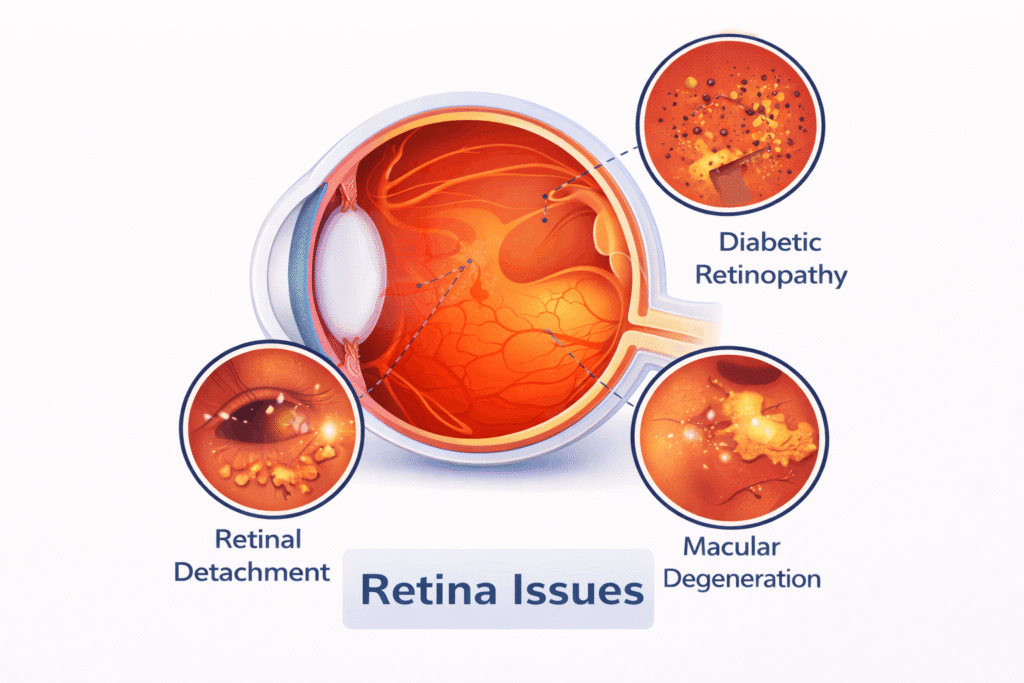
We routinely manage a wide range of conditions such as diabetic retinopathy, retinal vein occlusions, age-related macular degeneration, retinal detachment, and other vitreoretinal disorders. Retina Treatment is planned in a very personalised manner depending on the stage and severity of the disease. Services include intravitreal anti-VEGF injections, laser photocoagulation, and surgical retina care when required.
What makes our approach different is the emphasis on early detection and regular follow-up, especially for patients with diabetes and hypertension, where retinal involvement is often silent in the beginning. We believe that timely treatment can preserve vision and prevent irreversible damage in most cases.
At ARC Eye and Retina Hospital, every patient is evaluated with careful attention and managed with a clear, simple explanation of their condition so they feel confident about their treatment journey. Our aim is not just to treat disease but to protect and preserve vision for the long term in a trustworthy and ethical manner
Common Retinal Conditions We Treat
RETINAL SCREENING
In diabetes to rule out diabetic retinopathy, high myopia to rule out any lattices or hole , hypertensive retinopathy, ROP screening in neonates.
RETINAL LASER
Is done for myopia for retinal lattice and hole is proliferative diabetic retinopathy to prevent bleeding in the retina. In CSR to prevent leak, in retinal venous occlusion, in retinal vasculitis, in ARMD
RETINAL INJECTION
like ranibizumab, aflibercept, brolucizumab, farcimab and Ozurdex, injection of triamcinolone is done to prevent macular oedema and regress abnormal vessels in the retina to prevent bleeding. Retinal holes and tears are lasered to prevent retinal detachment. In ROP, laser is used to prevent vision loss.
RETINAL SURGERY
RETINAL SURGERY is done for retinal detachment, in diabetic retinopathy, hypertensive retinopathy, in ROP, in vasculitis, in cataract surgery complication like nucleus drop or IOL drop. In endophthalmitis, to remove infection from the eyes.
Advanced Diagnostic Technology for Precise Results
At ARC Eye and Retina hospital, Gurgaon, we strongly believe that accurate diagnosis is the foundation of good eye care. For this reason, we have invested in advanced diagnostic technology that allows us to examine the retina in great detail and detect even the smallest early changes that may affect vision.
Our eye hospital is equipped with modern tools like Optical Coherence Tomography (OCT), fundus fluorescein angiography, wide-field retinal imaging, and digital fundus photography. These tests help us understand retinal diseases in a much clearer and deeper way, especially in conditions like diabetic retinopathy, macular degeneration, retinal vein occlusions, and retinal detachment.
With these technologies, we are able to plan treatment more precisely and at the right time, which often makes a major difference in preserving vision. It also helps us monitor disease progression closely and adjust treatment whenever required.
At ARC Eye and Retina Hospital, we keep the process simple and patient-friendly, ensuring every report is explained properly so patients understand their eye condition without confusion. Our focus is always on clarity, accuracy, and timely care for the best possible visual outcomes.
Retina Surgery in Gurgaon: Modern & Minimally Invasive
Modern MIVS (Micro Incision Vitreoretinal Surgery) is a new and advanced way of doing retina surgery using very small cuts in the eye. In simple terms, it is a “keyhole surgery” for the retina, where delicate instruments are used to treat serious eye problems without making large openings.
In earlier times, retina surgeries required bigger cuts and longer recovery. But with MIVS, the cuts are so small that they usually do not need stitches, and the eye heals faster with less discomfort. This technique is commonly used for conditions like retinal detachment, diabetic eye complications, vitreous hemorrhage, and macular problems.
The surgery is done using high precision machines that allow the surgeon to work inside the eye in a very controlled and safe manner. Because of the small incision size, patients often experience quicker recovery, less irritation, and better post-operative comfort.
At ARC Eye and Retina Hospital, we use modern MIVS techniques to provide safer and more effective retinal care. The goal is always to restore vision with minimal trauma to the eye and faster return to daily activities
When to Visit a Retina Specialist: Warning Signs
You need to visit retina specialist if:
Sudden loss of vision in one or both eye
Sudden onset of floater or black spots
Sudden onset of scotoma
Any metamorphopsia, or seeing lines distorted
Any pain redness or photophobia
History of diabetes, hypertension, vasculitis, uveitis
Family history of glaucoma, retinal detachment or any history of retinal surgery before
Early examination can often prevent permanent vision loss with timely treatment like laser, injections, or surgery depending on the condition.
At ARC Eye and Retina Hospital, we encourage patients not to wait for symptoms to worsen. A simple retinal check-up at the right time can make a major difference in saving vision and ensuring long-term eye health.
FAQ
The investment for retina surgery in Gurgaon depends on the complexity of the condition, such as a retinal detachment or macular hole. The total reflects the advanced microsurgical instruments, laser technology, and specialized gases or silicone oils required to stabilize the retina effectively.
No, retina surgery in Gurgaon is performed under local anaesthesia with sedation or general anaesthesia, ensuring you feel no pain during the procedure. You may experience mild grittiness or soreness for a few days after, which is easily managed with prescribed eye drops.
Generally, the retina cannot repair itself. While minor tears might be treated with a simple laser by a retina specialist in Gurgaon, more serious conditions like detachment require surgical intervention to prevent permanent vision loss and reattach the tissue.
You should visit a retina specialist in Gurgaon immediately if you notice sudden flashes of light, a shower of new floaters, or a dark curtain-like shadow over your vision. These are often signs of retinal issues that require urgent professional evaluation.
Initial healing from retina surgery in Gurgaon usually takes 1 to 2 weeks, though full visual stabilisation can take several months. If a gas bubble is used during surgery, you may need to maintain a specific head position to ensure the best retina surgery outcome.
Yes, if a complex condition, such as a recurrent detachment, occurs, a retina specialist in Gurgaon may perform a second surgery. Success rates for repeat procedures remain high when handled by an experienced surgeon using advanced vitreoretinal techniques.
Yes, it is a highly delicate microsurgery; however, it is typically performed as a day-care procedure. This means you can have the best retina surgery in Gurgaon and return home the same day without needing an overnight hospital stay.
With an expert retina specialist in Gurgaon, the primary success rate for reattaching the retina is approximately 85% to 90%. Early diagnosis and prompt surgical intervention are the most critical factors in achieving the best possible visual recovery.
If your retina surgery in Gurgaon involved the use of a gas bubble, you must not fly or travel to high altitudes until the bubble has completely dissolved. Doing so can cause a dangerous rise in eye pressure; your surgeon will confirm when it is safe.
Choosing the best retina specialist in Gurgaon ensures access to high-precision diagnostics like OCT and advanced surgical systems. Expert specialists provide the specialized care needed for complex cases, significantly reducing the risk of complications and long-term vision loss.
Our Services
Working Hours
Monday:
9am – 7pm
Tuesday:
9am – 7pm
Wednesday:
9am – 7pm
Thursday:
9am – 7pm
Friday:
9am – 7pm
Saturday:
9am – 7pm
Sunday:
11am – 2pm
( Appointment Only )
How can we help you?
ARC Eye and Retina Centre delivers advanced eye and retina care with expert doctors, modern technology, and compassionate patient-focused treatment.