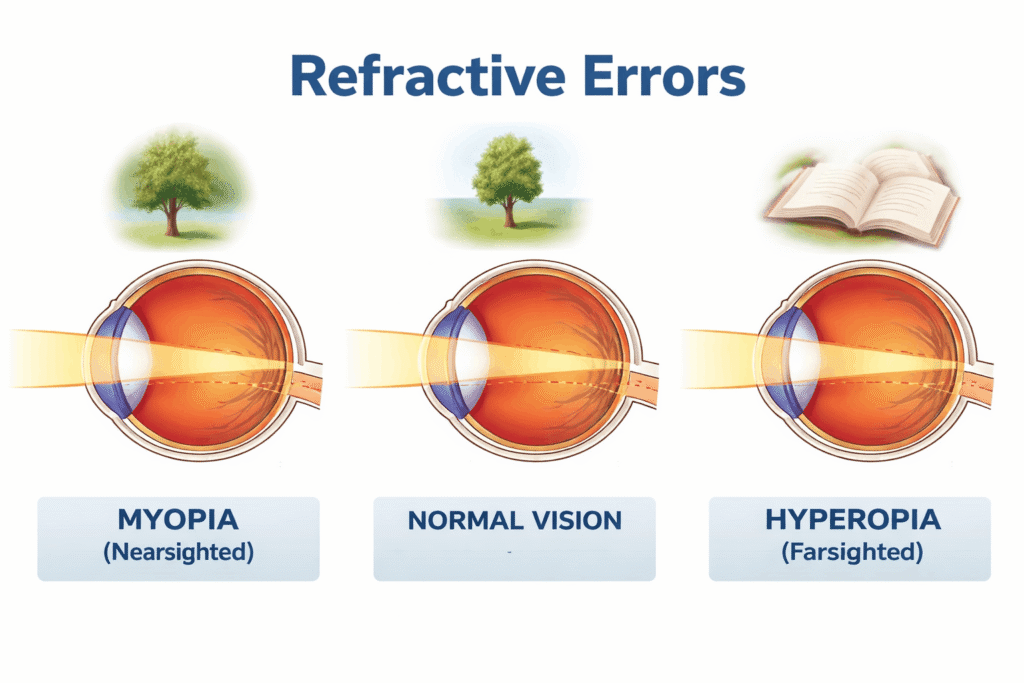
Refractive Errors
What is Refractive Eye Surgery?
Refractive surgery refers to a procedure done in the eye to remove the need for glasses and contact lenses or reduce the dependence on glasses, which is done if a patient has refractive error in the eyes, like MYOPIA, HYPEROPIA, ASTIGMATISM, or presbyopia.
Depending upon the amount of refractive error and condition of the eye, various refractive surgical procedures are done like LASIK, PRK, SMILE, SILK, and ICL. Principal of refractive surgery is to focus light on the fovea by means of the above procedure without glasses or contact lenses.
Before performing refractive surgery a comprehensive eye evaluation is done like corneal thickness, anterior chamber depth, and refractive error and dilated retina examination to rule out any pathology in eye before surgery.
All refractive surgical procedure are day care surgeries with an overall time of 10-15 mins with quick recovery. From the next day, the patient's vision is restored, although it takes a month for full recovery, but the patient can resume work from the very next day. All refractive procedures are painless, all procedures are done at the cornea level except ICL.
Types of Refractive Laser Eye Surgery: LASIK, SMILE, and Beyond
LASIK- (Laser-Assisted In Situ Keratomileusis)
With LASIK, your ophthalmologist uses a laser to change the shape of your cornea. This laser eye surgery improves the way light rays are focused on the retina. LASIK is used to treat myopia (nearsightedness), hyperopia (farsightedness), and astigmatism. LASIK involves creating a corneal flap using a microkeratome or a femtosecond laser, reshaping the cornea using an excimer laser to remove tissue from the underlying stromal bed and then replacing the flap.
Nearsightedness (Myopia): Up to(-8.00 to -12.00) diopters.
Farsightedness (Hyperopia): Up to(+5.00 to +6.00) diopters.
Astigmatism: Up to 5.00 to 6.00 diopters
- You should be 18 years or older (ideally, over 21 years old, when vision is more likely to have stopped changing).
- Your eye prescription should not have changed much in the last year.
- Your refractive error must be one that can be treated with LASIK.
- Your corneas need to be thick enough and healthy, and your overall eye health must be generally good.
- You need to have realistic expectations about what LASIK can and cannot do for you.
SMILE - Small Incision Lenticule Extraction
It uses a femtosecond laser to create a lenticule within the stroma of the cornea, which is then manually removed through a small peripheral incision to correct myopia and myopic astigmatism femtosecond laser forms an intrastromal lenticule with a small incision. The lower interface is first formed, and then the upper interface, which is known as the cap.
A tunnel incision of 2-3 mm is created, which connects this cap interface with the corneal surface. The excision of the lenticule is then performed through blunt separation of the anterior and posterior surfaces, followed by removal with retinal micro-forceps or a lenticule stripper instrument.
Benefits of SMILE1 Minimally invasive, High precision, Bladeless, Single laser step, No corneal flap created, Minimal effect on corneal nerves supplying the tear glands, Minimal downtime, especially for swimming and contact sports
SMILE (Small Incision Lenticule Extraction) is designed to correct specific vision issues within the following parameters:
- Nearsightedness (Myopia): -1.00 D to -10.00 D.
- Astigmatism: Up to 5.00 D
PRK PHOTOREFRACTIVE KERATECTOMY
PRK was the first kind of corrective eye surgery to use a laser rather than a blade to remove corneal tissue It is generally most effective for low-to-moderate refractive errors and is an ideal alternative for patients with corneas too thin for LASIK
During the procedure, an instrument holds the eyelid open, and the patient is asked to focus on a target light. The surgeon then removes the surface layer of the cornea (the corneal epithelium) and uses an excimer laser to apply computer-controlled pulses of light energy to reshape the cornea.
Recovery after PRK takes a few days because it takes 3-4 days to grow epithelium after surgery till then contact lens is put on cornea
Smooth Incision Lenticule Keratomileusis (SILK)
Smooth Incision Lenticule Keratomileusis (SILK) is the KLEx procedure performed on the ELITA Femtosecond Laser System from Johnson & Johnson. This KLEx procedure uniquely uses a bi-convex lenticule, enabling smoother dissection and lenticule extraction, hence the name, and it's the latest technology of refractive surgery
Implantable Collamer Lens ICL
Implantable Collamer Lens (ICL) surgery typically corrects nearsightedness (myopia) from -0.5 D to -20.0 D and astigmatism up to 4.0D up to 6.0 D for certain lens models. It is an ideal option for patients with high prescriptions or thin corneas who do not qualify for LASIK
It is an invasive procedure in which a thin lens is implanted above the natural lens, which helps focus the light on the retina.
Most suitable for a high refractive error patient or a patient involved in contact sports. This is a reversible process and needs to be removed in old age if cataract surgery is required.
Key Benefits of Choosing Refractive Surgery
Refractive surgery can improve the quality of life by eliminating the inconvenience associated with spectacles and contact lenses. Cosmetically looks better in both male and female
Clear and sharp vision allowing patients to perform daily activities such as reading, driving, working, and participating in sports with greater convenience and comfort.
Short recovery time
Day care procedure
Modern refractive surgical techniques are highly precise, safe, and effective when performed on appropriately selected candidates.
Are You a Candidate for Refractive Laser Eye Surgery?
If you are above 18 years of age, no change of glasses or prescription of more than 0.5D in the last 6 months and willing to get rid of glasses.
You are fully aware of the process it involves other parameter including corneal thickness and everything falls under the safe limit. It should not be performed in unstable refraction.
Abnormalities of the cornea (e.g., keratoconus or other corneal ectasias, thinning, oedema, interstitial or neurotrophic keratitis, extensive vascularisation) Insufficient corneal thickness for the proposed ablation depth Visually significant cataract Uncontrolled glaucoma Uncontrolled external disease (e.g., blepharitis, dry eye syndrome, atopy/allergy) Uncontrolled autoimmune or other immune-mediated disease Uncontrolled mental illness, including anxiety or depression.
Unrealistic patient expectations
Procedure and Recovery Timeline for Refractive Eye Surgery
All the refractive procedures are quickly done under topical anaesthesia, do not cause any pain during the procedure with a quick recovery time.
Only in PRK slightly longer recovery period because it takes around a week for the full growth of the epithelium procedure; In all the above procedure, the patient is explained about the procedure he/she undergoing. Informed consent is taken patient shifted to operation theatre, Topical anaesthesia is applied under sterile conditions, laser ablation of the cornea is done.
The patient is given dark glasses/protective eyewear to use for a week. Next follow-up is done on the next day, where a full vision examination with slit lamp examination is done.
After the procedure, a few drops are advised, including an antibiotic, a steroid and a lubricant drops are advised for a few months post op, other drops are stopped after 2-3 weeks . Postoperative period patient are advised to protect their eyes from trauma.
Avoid direct water splashes in the eye for at least 7 days. Patients are advised to resume daily work after 3 days, although if necessary can start working from the next day.
FAQ
The investment for refractive eye surgery in Gurgaon varies based on the specific technology used, such as LASIK, SMILE, or Contoura Vision. Factors like the complexity of your prescription and the choice of advanced laser systems will determine the final treatment plan tailored to your needs.
No, refractive laser eye surgery is virtually painless as it is performed using numbing anesthetic eye drops. While you may feel a slight sensation of pressure during the 10-minute procedure, most patients report little to no discomfort throughout the process.
Yes, in some cases, a "touch-up" or enhancement procedure can be performed if your vision shifts over time. However, most lasik refractive surgery results are permanent, and a second procedure is only considered after a thorough evaluation of your corneal thickness and eye health.
Generally, candidates must be over 18 with a stable prescription for at least one year and healthy corneas. A comprehensive pre-operative screening at our center helps determine which refractive eye surgery in Gurgaon is safest and most effective for your unique eye structure.
Most patients experience significantly clearer vision within 24 to 48 hours after the procedure. While you can typically return to work and light activities within a couple of days, full visual stabilization from refractive laser eye surgery usually takes a few weeks.
While all refractive laser eye surgery aims to reshape the cornea, techniques vary; LASIK involves creating a small flap, while SMILE is flapless and minimally invasive. Your surgeon will recommend the best method based on your lifestyle and corneal mapping results.
Yes, modern refractive eye surgery in Gurgaon is highly effective at correcting not just nearsightedness and farsightedness, but also astigmatism. By precisely reshaping an irregular cornea, the laser allows light to focus correctly on the retina for sharp vision.
The physical reshaping of the cornea during lasik refractive surgery is permanent and intended to last a lifetime. However, natural age-related changes, such as presbyopia (needing reading glasses after age 40), can still occur and may require separate management.
Temporary side effects may include dry eyes, glare, or halos around lights at night, which usually resolve as the eyes heal. Choosing an expert provider for refractive laser eye surgery in Gurgaon ensures these risks are minimized through advanced diagnostic technology.
You can usually resume light exercise like walking within two days of your lasik refractive surgery. However, it is important to avoid swimming and contact sports for at least two weeks to protect the eyes from irritation or accidental trauma during the healing phase.
Our Services
Working Hours
Monday:
9am – 7pm
Tuesday:
9am – 7pm
Wednesday:
9am – 7pm
Thursday:
9am – 7pm
Friday:
9am – 7pm
Saturday:
9am – 7pm
Sunday:
11am – 2pm
( Appointment Only )
How can we help you?
ARC Eye and Retina Centre delivers advanced eye and retina care with expert doctors, modern technology, and compassionate patient-focused treatment.