
Cataract Treatment & Surgery at ARC Eye Centre
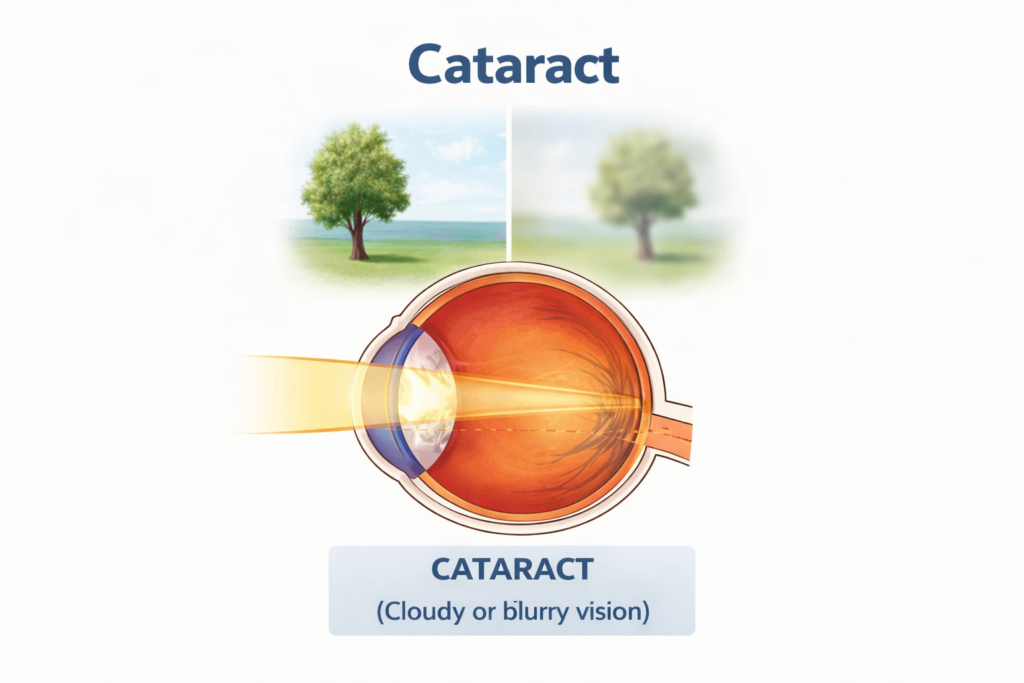
What is Cataract Surgery?
Cataract surgery refers to the removal of the cataractous lens by any surgical means. It has evolved from couching in the early era to ICCE, intracapsular cataract extraction, to ECCE, extra capsular cataract extraction, to small incision cataract surgery, SICS, to phacoemulsification, to femto cataract surgery with phacoemulsification till now. In the modern era, cataract surgery is generally painless, quick and with topical anaesthesia that is achieved by instilling drops only.
After removal of the cataract or natural opacified lens, an artificial intraocular lens is implanted,
The whole process of cataract surgery takes generally 15-30 minutes, and usually a bandage is applied for a few minutes post-surgery; sometimes, even a bandage is not needed. Vision often improves within days, though full healing takes weeks. Eye drops are prescribed to prevent infection and reduce inflammation, which consist of drops of antibiotics, drops of a steroid and lubricants
Cataract surgery has a high success rate of nearly 100% of patients experiencing significantly better vision. Risks are rare but include infection, bleeding, or retinal detachment.
Common Indications and Clinical Symptoms of Cataracts
The most common indication of cataract surgery is when it starts to interfere with your daily life activities. The most common indication is reduced visual acuity leading to difficulty in reading, driving, recognising faces, watching television, or performing occupational tasks.
Surgery is also indicated when there is a problem in driving, Glare, Halos, or reduced contrast sensitivity, Diplopia.
Sometimes cataract surgery is needed to preserve vision from further damage, like phacomorphic glaucoma, phacolytic glaucoma, and uveitic glaucoma. Cataract Surgery is also needed if the posterior part of the eye is not visible due to a cataract, to see the retina, such as diabetic retinopathy, hypertensive retinopathy and ARMD.
In neonates, if they have a cataract, it's necessary to remove the cataract to prevent amblyopia, especially when the cataract is unilateral.
Another indication of cataract surgery is refractive lens exchange when refractive surgery is not possible for any reason. In that case, a clear lens is removed, and an IOL is implanted
Sometimes cataract removal is done to facilitate the retinal surgery, or during retina surgery, if lens touch happens, then the cataract is removed to prevent postoperative vision loss.
Types of Cataract Surgery
The most commonly performed procedure is phacoemulsification, in which ultrasonic energy is used to break the cloudy lens into small fragments that are removed through a small incision. A foldable intraocular lens (IOL) is then implanted. This technique allows rapid visual recovery, minimal astigmatism, and faster healing.
Other types of cataract surgeries are
- ICCE
- ECCE
- SICS
- MICS
- FEMTO CATARACT SURGERY
Cataract surgery has evolved immensely in the last few decades. In the early era, COUCHING was done in which the lens was pushed inside the eye. In ICCE, the whole lens with capsule is removed, and the patient is left aphakic, and later glasses are prescribed.
In ECCE, the cataract is removed, the capsular bag is preserved, and the IOL is implanted in the bag or sulcus. In the two above surgeries, a large incision is made, and a suture is required to close the wound, and the recovery time is longer.
In SICS, through a self-sealing wound, a lens is removed, and an IOL is put in a bag, slightly older technology, but still performed specially by an older surgeon and in rural areas
What Causes Cataracts?
ACQUIRED CATARACT
The most common cause of acquired cataract is age-related cataract, called senile cataract. It starts to show minor changes typically after 45-50 years of age, but varies patient to patient; sometimes it does not show any changes even in the eighties.
Other acquired cataracts are due to systemic disease, like Diabetes mellitus, Hypertension, and Myotonic dystrophy.
Secondary Cataract
A secondary (complicated) cataract develops as a result of another primary ocular disease. Like uveitis, glaucoma, high myopia and traumatic ocular injury. It can also be associated with drugs, most commonly steroids in any form.
CONGENITAL CATARACT
Cataract in the pediatric age group is mostly a congenital cataract, which occurs in about 3 in 10 000 live births. Two-thirds are bilateral, and a cause can be identified in about half of these. Autosomal dominant (AD) inheritance is the most common aetiological factor; others include chromosomal abnormalities, metabolic disorders and intrauterine infections.
Isolated inherited Congenital cataracts carry a better visual prognosis than those with coexisting ocular and systemic abnormalities. Unilateral cataracts are usually sporadic, without a family history or systemic disease, and affected infants are usually otherwise healthy
Risk Factors for Cataracts
The most important risk factor is increasing age, as degenerative changes in lens proteins occur naturally over time. Diabetes mellitus is another major risk factor and can lead to earlier and faster cataract formation due to osmotic and metabolic changes within the lens.
Prolonged exposure to ultraviolet (UV-B) radiation from sunlight increases oxidative damage to lens fibres and contributes to cataract development. Smoking and excessive alcohol consumption are also strongly associated with cataract because they increase free radical formation and oxidative stress. Long-term use of corticosteroids, especially systemic or topical steroids, is known to cause posterior subcapsular cataract.
Other ocular risk factors include trauma, chronic uveitis, high myopia, retinal disorders, and previous intraocular surgery. Poor nutrition, especially a deficiency of antioxidants and vitamins, may also increase susceptibility. Exposure to radiation, electrical injuries, and certain medications can contribute to lens opacity. Genetic predisposition and family history may influence the risk of developing cataract at an earlier age. Understanding these risk factors is important for prevention, early detection, and timely treatment to reduce visual impairment and blindness caused by cataract.
Tests and Diagnosis for Cataracts
Diagnosis of cataract starts with the patient's complaints of decreased vision in one or both eyes. The examination is performed starting from taking vision with and without glasses then diagnosis is done on slit lamp examination which give us good idea of grade of cataract and need of surgery for the cataract, further dilated examination is done to rule out any other pathology in eye which cause this decrease in vision, once cataract diagnosis is made and test are done to determine the power of IOL, like biometry which can either ultrasonic or optical, which gives us the power IOL.
Patient is informed about the various lens its pros and cons, and according to the patient's need, IOL is chosen. Few tests are done, like BLOOD SUGAR. Blood pressure and viral marker that includes HIV, HCV, and HBsAg to know the systemic condition.
In case of a mature cataract, an ultrasound B-scan of the eye is done to determine any posterior pathology. In case of any retina abnormality, an OCT is done.
FAQ
The cataract surgery cost depends on the surgical technique (like Robotic or MICS) and the specific Intraocular Lens (IOL) you choose. Factors such as the lens technology and hospital facilities will determine the final estimate provided during your consultation.
No, the procedure is virtually painless as it is performed under local anesthesia using numbing eye drops. Most patients only feel a slight sensation of pressure during the quick 15-minute process.
No, the natural lens is permanently replaced, so it cannot be "redone." If vision becomes cloudy later, it is usually a "secondary cataract," which is easily cleared with a 5-minute laser treatment called YAG Capsulotomy.
Most patients experience clearer vision within 24 to 48 hours. While you can resume light daily activities almost immediately, full healing typically takes about 4 to 6 weeks.
No, you must arrange for someone to drive you home because your vision may be blurry and your eyes will be sensitive to light. Your eye doctor in Gurgaon will let you know when it is safe to drive, usually after your first follow-up.
It depends on your lens choice; Monofocal lenses usually require reading glasses. Choosing premium Multifocal or EDOF lenses can significantly reduce or eliminate your need for glasses for both near and far distances.
Surgeons use a gentle medical device to keep your eye open, so blinking is impossible during the procedure. Numbing drops also minimize the urge to move, and advanced surgical tech accounts for any minor eye shifts.
While it is a highly precise microsurgery, it is an outpatient (day-care) procedure. You do not need an overnight hospital stay and can typically go home just a few hours after arriving.
Usually, surgeons operate on one eye at a time, with a gap of 7 to 14 days in between. This allows the first eye to stabilize and ensures you have functional vision while the second eye heals.
Yes, as a medically necessary treatment, it is covered by most health insurance plans and TPAs. Many hospitals in Gurgaon also provide cashless facilities to make the process easier for patients.
Our Services
Working Hours
Monday:
9am – 7pm
Tuesday:
9am – 7pm
Wednesday:
9am – 7pm
Thursday:
9am – 7pm
Friday:
9am – 7pm
Saturday:
9am – 7pm
Sunday:
11am – 2pm
( Appointment Only )
How can we help you?
ARC Eye and Retina Centre delivers advanced eye and retina care with expert doctors, modern technology, and compassionate patient-focused treatment.